Every enterprise should be thinking about AI, no matter the size, industry, or geography. AI is the next wave of truly transformative technology with potential that we have not even begun to understand.
Previously, AI was used for very compact, purpose-built tools that helped to make predictions or automate processes. Today, we see it taking a more active role as a co-pilot. In this co-pilot phase, there is a tremendous opportunity to revolutionize internal business processes, customer engagement, and the opening of new markets – to transform how we operate today. Leaders who take proactive steps to leverage this transformative technology within the enterprise will run companies that thrive in an AI world.
If you feel unsure how to proceed, you are not alone. Like any business-planning exercise, there are challenges to overcome with thorough planning and experimentation. You need to craft an AI strategy framework that engages your workforce and provides enough guidance to ensure that it is used in a secure, ethical, and cogent fashion. These challenges, if not addressed with a broad-based strategy and a cohesive AI framework for businesses, will doom the enterprise to never realize the full potential of AI.
This post will outline a strategy to help you to avoid this costly mistake many enterprises unfortunately will make (if they haven’t already). Within this AI strategy framework, we highlight three basic pillars to effectively deploy AI while mitigating these operational challenges: People, Process/Policy, and Technology. In this post, the second of a three-post series, we will discuss the Process/Policy pillar. You can view the first post on the People pillar here.
A good AI policy and process strategy provides enough guidance on how AI will be developed, reviewed, and deployed without stifling creativity. Below, you will find a 7-step framework for applying AI in the enterprise and building your own strategy, tailored to your specific needs.
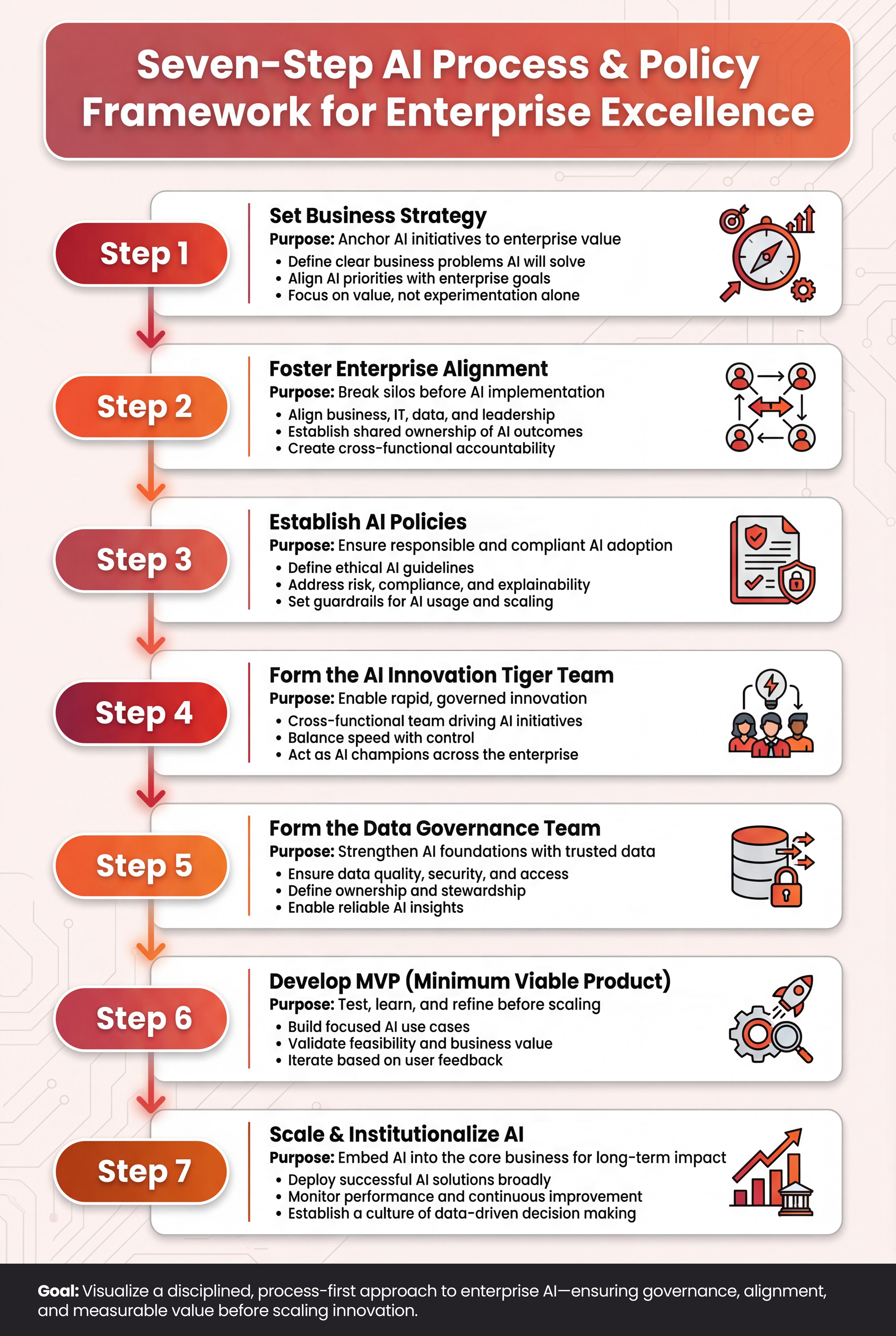
Creating Your AI Process Development Strategy
The Innovation Tiger Team’s responsibilities are:
-
Establish the business strategy first.
The best AI strategy frameworks are set without even initially discussing AI. These begin with executive leadership first setting the strategic imperatives for the business. These could be everything from revenue generation to deeper customer engagement to increased productivity. These imperatives are the business’s North Star and only once these are set can AI then be investigated as a potential solution toward meeting these imperatives or strategies. AI needs to be deployed to solve a problem, not just for the sake of using AI.
-
Foster alignment across the enterprise.
Once core strategies and imperatives are set at the executive level, make a concerted effort to align and push these down through leadership in the various groups, units, and divisions within the enterprise. Business leaders will then work with their teams to identify any gaps or opportunities within their respective groups and build business cases on how AI could potentially act as a solution.
This bottoms-up approach, reinforced by an effective AI framework for businesses, fosters design thinking and enables a creative problem-solving mindset. One way to think about this is in terms of what Amazon did in the 2010’s.
Jeff Bezos challenged his leaders to use AI to power the business forward. Bezos leaned on his leaders to transform Amazon into an AI powerhouse. Bezos asked his leaders questions such as “How can you use these techniques and embed them into your own business” or “how can AI transform the customer experience?” Business leaders were asked to create a 6-page business case complete with press release to describe to Bezos these new AI-driven features, capabilities, and experiences.
Amazon also established a process and policy to enhance the creative process. This process was called the “flywheel.” The flywheel approach keeps AI innovation moving forward and encourages energy and knowledge to spread to other areas of the company. To further Amazon’s drive to embed AI in their culture, the company has expanded their training and upskilling programs to recruit, train, and deploy the next generation of employees who are fluent in AI. Due to its commitment to AI, Amazon delivered three seminal AI-based technologies that are now part of everyday life (Alexa, the Amazon Go Store, and the Amazon recommendation engine).
-
Establish AI Use Policies.
Generative AI is proving to provide significant benefits for enterprises. AI can be applied in many different industries, for internal or external use, to tap into new markets, or create new offerings for customers. It is also important to acknowledge that AI is still in its infancy and as more work is done with AI, a need for an enterprise-wide AI strategy framework and policy is more important. AI is not perfect and implementing and enforcing a set of guiding policies will help the enterprise as it navigates the AI landscape. Examples of what to include in an AI policy include:
-
A vision for AI usage and growth in the organization.
-
Mission statements and objectives that align with the vision.
-
List of approved third-party or internal AI tools
-
Compliance with regional, regulatory, and industry-specific laws, regulations, and authorities.
-
An inventory and procedure for data privacy and security mechanisms.
-
A defined procedure for reporting and addressing AI performance and security issues.
-
Standards for AI model performance evaluation.
-
Ethical use of AI.
The policies should be developed by a cross-functional team including legal, data governance, cybersecurity, IT, business ethicists, and C-level representation. Enforcement of the policies would be done through the Innovation Tiger Team.
-
Establish an Innovation Tiger Team.
This team works with business leaders across the enterprise in advising on the use of AI and developing the framework for next gen procurement to solve business problems. Ideal team candidates are individuals from multiple departments, including:
-
Legal
-
As an example, Legal would review the proposed solution for any GDPR or legal/privacy implications.
-
IT
-
IT would be involved to opine on whether the solution should be built internally or leverage third-party platforms.
-
Business line leadership
-
Leadership is involved to validate that the proposed solution will solve a problem, enhance revenue, or enhance the customer experience.
-
Cybersecurity
-
Cybersecurity would review the proposed solution to determine if there are any vulnerabilities, which could be exploited by bad actors.
-
Data Governance
-
Data governance would be responsible for determining the data source and models for the proposed AI solution. Data governance would work with IT and cybersecurity to determine the best development and deployment method based on the sensitivity of the data to be used.
-
Prioritization of business cases proposed by the business teams, according to internal evaluation criteria.
-
Applicability to the gap/opportunity and meeting the strategic imperatives laid out by executive leadership
-
Technical needs and challenges such as deciding between building the solution in-house or using a third-party platform
-
Speed to value
-
Perceived risks including ethical, data, and security. Guide rails should be established to show what the company will allow and prohibit, or what the limits can be.
-
Ensuring that there are no legal ramifications.
-
Recommendation of changes or updates to business cases based on the prioritization review.
-
Recommendation of changes or updates to AI policies to reflect any experiences and learnings.
-
Approval of AI business cases to move to development and deployment
-
Establish a Data Governance team.
The importance of a data governance team, particularly where AI is concerned, cannot be overstated. This team is responsible for the processes, policies, roles, metrics, and standards that ensure an effective and efficient use of data. Specific to AI, organizations will need to scale these data management and governance teams to increase the trust, security, and ethical use of the data in AI modeling and algorithms. Data governance teams also work with the IT group to establish data structures and repositories that can be used in current business functions and for AI-driven initiatives and AI strategy frameworks. Such structures include a blend of data warehouses and data lakes (forming a data “lakehouse”).
-
Develop Minimum Viable Product (MVP).
Once AI business cases have been approved, an MVP should be developed. Before the MVP is developed, however, the Tiger Team would determine the best technology to use (e.g., third-party solutions or build in-house) to maximize value but mitigate any risks. As an example, if an AI-driven solution will use confidential customer data then it would make sense to build the solution internally rather than leverage third-party tools lest any data breach expose this confidential information. Once built, the MVP would be tested and reviewed once more by the Tiger Team to ensure that the technology has solved for the business case and meets all applicable legal, data, ethics, and security requirements.
-
Develop Key Performance Indicators and deploy.
Before deployment of the AI solution, develop a set of Key Performance Indicators (KPIs). These KPIs should track how well the solution is performing relative to the stated objectives/business case of the AI solution. When establishing these KPIs, consider the following best practices.
-
Focus more on business metrics than financial metrics, and follow measures tied to the use case.
-
Identify metrics early and measure the success of AI use cases quickly and consistently.
-
Business metrics can include those focused on:
-
Business growth, e.g., cross-selling potential, price increases, demand estimation, monetization of new assets
-
Customer success, e.g., retention measures, customer satisfaction measures, share of customer wallet
-
Cost-efficiency, e.g., inventory reduction, production costs, employee productivity, asset optimization
See how WNS supports enterprises in developing secure and practical AI processes.
Taking the Next Step
After using this strategy outline to thoroughly plan your own AI integration process, you are ready to deploy your solution. The most important part of any business strategy is that it remains flexible enough to adapt to changing needs. Your policies should embrace agility and creativity, maintaining a continuous learning mindset. The KPIs you develop will give you advanced insights into what needs to be improved, and your teams will use that knowledge to adjust your policies moving forward.
Every company’s AI journey is different, but their commonality is that they all start somewhere. Trust in your process and be resilient: digital transformation takes time, but when that time arrives, you will have an organization built to flourish in a progressing digital age. For more on digital transformation and AI framework for businesses, connect with us on LinkedIn and join the conversation!
Are you ready to build an AI strategy framework? Leverage our Procurement Advisory Solutions to seamlessly integrate AI into your procurement process.
FAQs
1. How can enterprises effectively implement an AI process and policy strategy?
A strong AI process policy strategy requires clear governance, defined workflows, responsible data usage, and consistent oversight to ensure reliable and scalable AI adoption.
2. What are the best practices for aligning AI initiatives with business goals?
Effective AI alignment best practices include identifying high-value use cases, involving business stakeholders, and ensuring AI projects directly support measurable organizational objectives.
3. How can organizations measure the ROI and business impact of AI solutions?
AI ROI measurement focuses on tracking cost savings, efficiency gains, accuracy improvements, and long-term strategic benefits delivered by AI initiatives.
4. How should companies decide between building AI solutions in-house or using third-party platforms?
An AI build vs buy strategy depends on internal capabilities, timelines, cost, and the complexity of use cases—balancing control with speed to value.
5. What steps can enterprises take to ensure ethical, secure, and compliant AI deployment?
A strong AI ethics compliance strategy includes bias checks, transparent governance, data security safeguards, and adherence to regulatory standards across the AI lifecycle.
6. How does WNS Procurement support enterprises in building secure, scalable, and responsible AI frameworks?
WNS Procurement helps enterprises design secure, scalable, and responsible AI governance frameworks by combining domain expertise, advanced analytics, and compliance-led methodologies to ensure safe and effective AI adoption.