Improve Your Procurement Ecosystem with Design Thinking Webinar
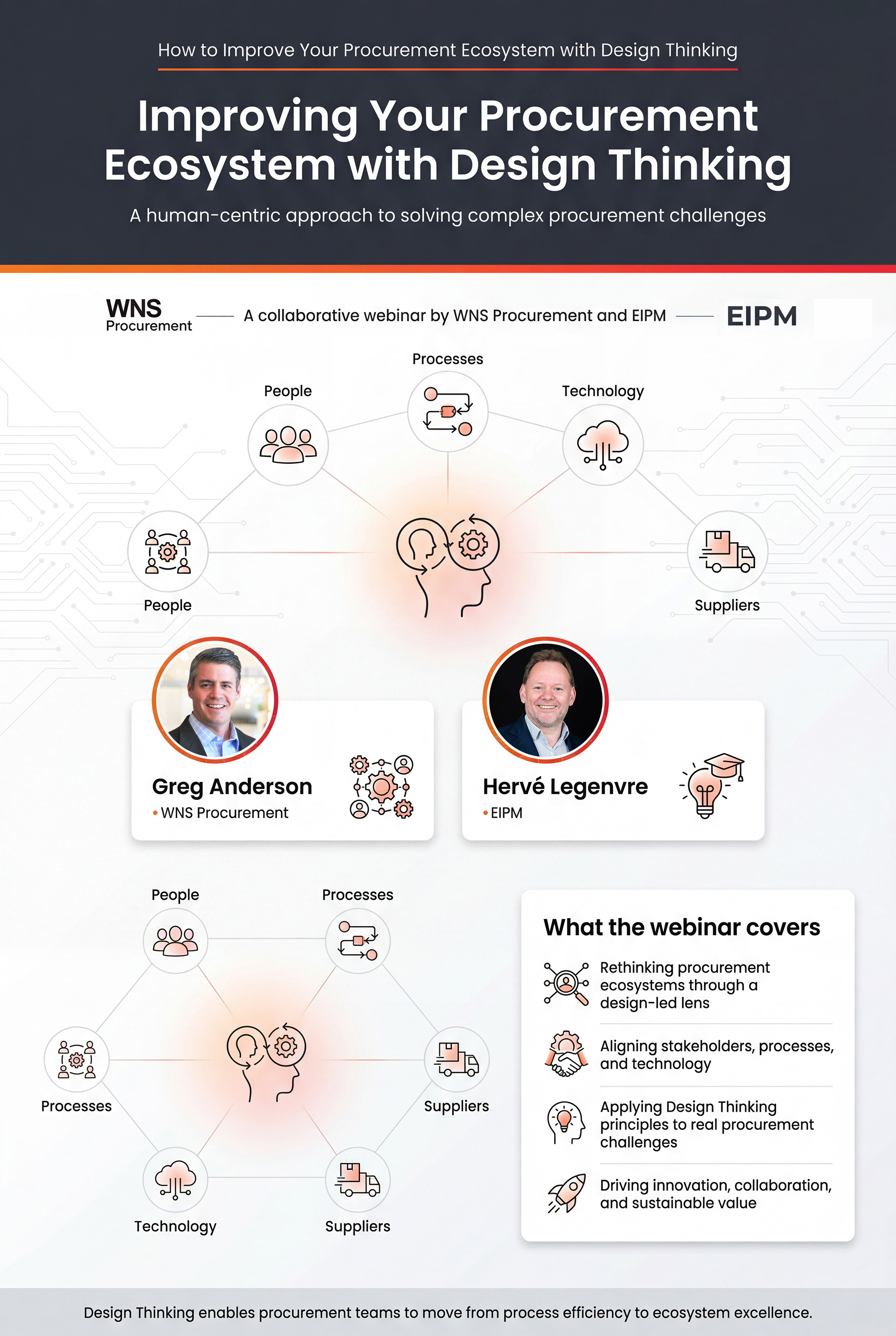
Have you ever found yourself in a meeting and thought, "Why do we keep doing the same thing OVER and OVER? I am ready to improve our old ways of working!” If so, you aren’t alone. Now is the time to learn about Design Thinking – or what many practitioners today refer to as procurement design thinking when applied to sourcing, supplier management, and value creation. Many people think Design Thinking is a new concept. Yet, this practice dates back to the 18th century. Design Thinking helps you reframe how you approach problems, conversations, and relationships at your organization.
Join Hervé Legenvre, Ph.D., Professor and Director of Value Creation Observatory at EIPM, and Greg Anderson, North America Practice Leader at WNS Procurement to learn:
The history of Design Thinking in under 5 minutes
The 5-step process of Design Thinking
How Procurement can apply Design Thinking concepts
What Design Thinking in procurement looks like in practice
Ultimately, Design Thinking is your tool to look at problems through a telescope - to see the big picture and understand how your business functions in a holistic way. Your entire procurement ecosystem benefits from Design Thinking. Now is the time to listen to that inner voice - out with the old ways of working and in with the new, innovative ways to do things differently.
Watch the full webinar on applying Design Thinking in procurement.
FAQs
1. What is Design Thinking and why is it relevant to procurement?
Design thinking procurement focuses on solving procurement challenges through empathy, creativity, and iterative problem-solving, helping teams design more user-centric processes and better stakeholder experiences.
2. How does the 5-step Design Thinking process work in practice?
The design thinking process steps—empathize, define, ideate, prototype, and test—guide procurement teams to deeply understand user needs, generate innovative ideas, and validate solutions before full-scale rollout.
3. What are practical examples of Design Thinking applied in procurement?
Common design thinking procurement examples include redesigning supplier onboarding journeys, improving category manager workflows, simplifying RFP processes, and creating intuitive digital procurement dashboards.
4. How can Design Thinking help improve a procurement ecosystem?
Design thinking procurement benefits include enhanced stakeholder satisfaction, clearer processes, faster problem resolution, improved collaboration, and solutions that align more closely with business needs.
5. What is the historical background of Design Thinking and how has it evolved over time?
The history of design thinking traces back to the 1960s, evolving from engineering and creative problem-solving methods into a structured framework widely used today across business, technology, and procurement innovation.
6. How does WNS apply Design Thinking to drive procurement innovation and better user experiences?
WNS design thinking procurement solutions use empathy-driven research, collaborative workshops, and rapid prototyping to redesign procurement processes, improve stakeholder experience, and deliver more agile, user-centric outcomes.